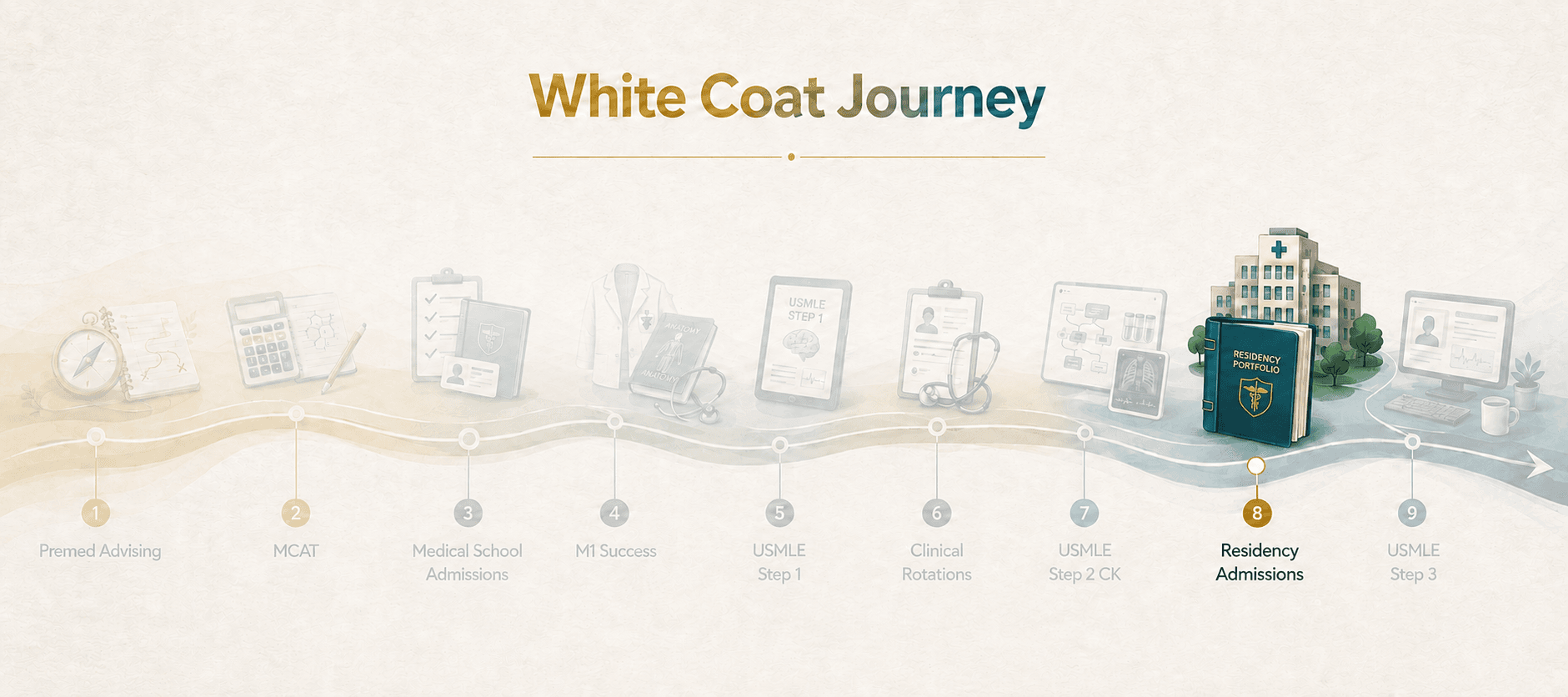
White Coat Journey
DDQX Approach to Residency Admissions
Build a Match strategy that makes your readiness easier to see.
By this stage, you have years of evidence: clerkship feedback, Step results, patient encounters, specialty decisions, research, leadership, service, and letters.
DDQX helps you turn that evidence into one coherent Match strategy across ERAS, interviews, and rank-list reasoning.

The Match can make strong applicants feel scattered.
By the time you apply to residency, you have accumulated a large amount of evidence. The challenge is deciding what that evidence is supposed to prove.
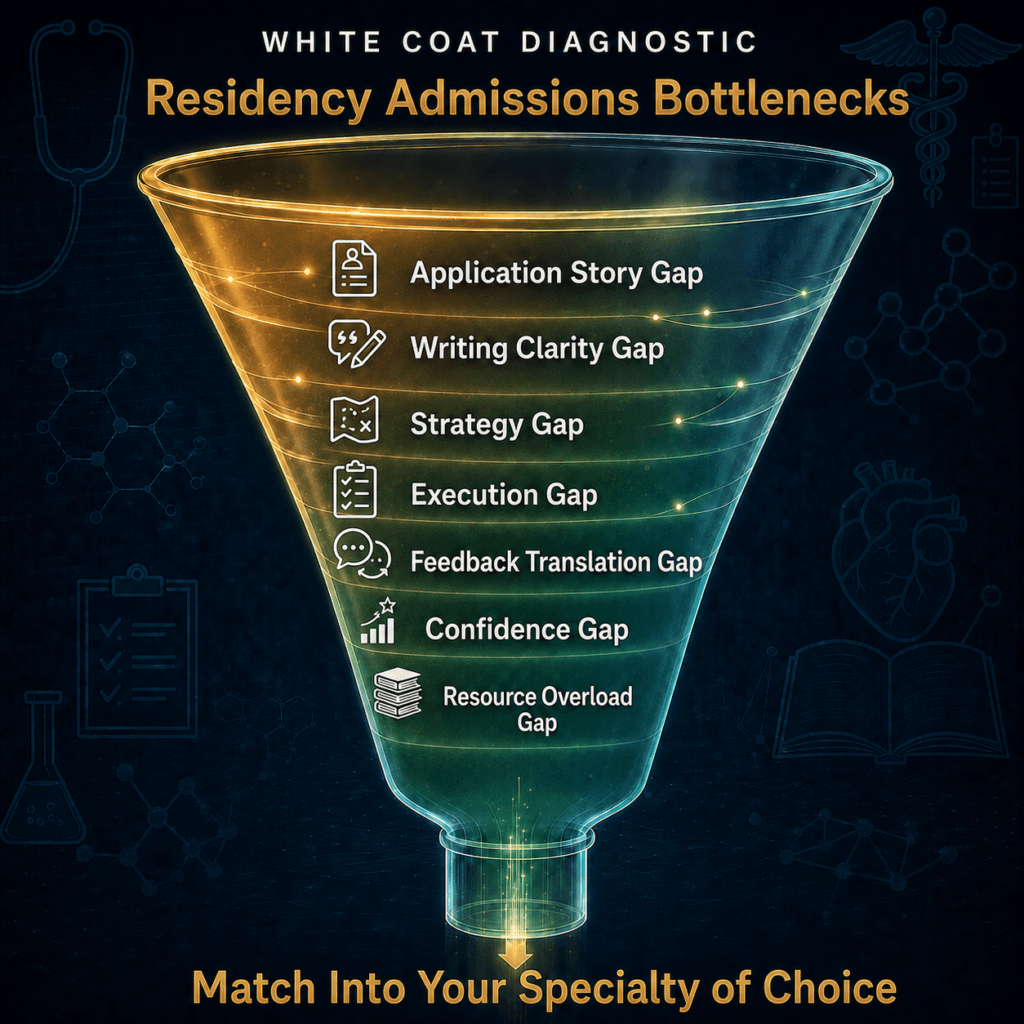
Applicants often build each piece separately and hope it will feel coherent when a program reads it.
If your residency admissions bottleneck is your application story, you may have meaningful clinical experiences, strong effort, and real reasons for choosing your specialty, but may not be connecting those pieces into one clear Match narrative.
This can show up as:
- ➢ An ERAS application that lists accomplishments without a clear central thread
- ➢ A personal statement that explains motivation but does not fully show specialty fit
- ➢ Experiences are individually strong but disconnected as a whole
- ➢ Interview answers do not consistently reinforce the same story
- ➢ Difficulty explaining why this specialty fits your strengths, values, and clinical identity
- ➢ An application that feels complete but not yet cohesive
The goal is to turn your clinical story into a coherent specialty-readiness narrative.
If your residency admissions bottleneck is writing clarity, you may know what you want programs to understand, but the writing may not yet make that message easy to see.
This can show up as:
- ➢ A personal statement that feels sincere but generic
- ➢ Experience descriptions that list responsibilities without showing growth
- ➢ Language that explains too much without landing on a clear point
- ➢ Specialty motivation that feels stated rather than demonstrated
- ➢ Reflections that are thoughtful but too vague to be memorable
- ➢ Application materials that do not fully align with your intended specialty
The goal is to make your application materials clearer, more focused, and more aligned with your intended specialty.
If your residency admissions bottleneck is strategy, you may be working on ERAS, your personal statement, letters, program list, signals, and interviews, but the pieces may not yet be organized around a single Match strategy.
This can show up as:
- ➢ Improving each application component separately without a clear overall plan
- ➢ Writing a personal statement before defining your specialty-fit thesis
- ➢ Building a program list without fully accounting for competitiveness, geography, signals, or fit
- ➢ Choosing stories that are meaningful but not strategically aligned
- ➢ Requesting or using letters without knowing what they need to reinforce
- ➢ Preparing interview answers that do not consistently support the same Match narrative
The goal is to build a Match plan that connects your application choices to your actual risk, goals, and timeline.
If your residency admissions bottleneck is execution, you may understand what needs to happen, but the work may not yet be moving forward with enough structure.
This can show up as:
- ➢ A personal statement stuck in revision
- ➢ ERAS experiences left unfinished
- ➢ Letters not fully planned or followed up on
- ➢ Program signals delayed
- ➢ Interview prep postponed
- ➢ Program research happening too late
- ➢ Too many Match decisions being made under deadline pressure
The goal is to turn the Match process into a system with clear priorities and fewer last-minute decisions.
If your residency admissions bottleneck is feedback translation, you may have received advice from advisors, residents, attendings, mentors, specialty faculty, peers, or online sources, but the feedback may not yet be turning into a stronger application.
This can show up as:
- ➢ Receiving conflicting advice from different people
- ➢ Revising your personal statement in circles
- ➢ Feeling unsure whether feedback reflects wording, strategy, specialty fit, or risk
- ➢ Changing application materials without knowing if they are actually stronger
- ➢ Getting advice that may be true for one specialty but not yours
- ➢ Losing your own voice while trying to satisfy too many reviewers
The goal is to sort feedback into useful categories and convert the right comments into concrete application changes.
If your residency admissions bottleneck is confidence, you may be carrying more uncertainty than your application deserves.
This can show up as:
- ➢ Over-editing the personal statement
- ➢ Avoiding interviews in your mind before they happen
- ➢ Comparing yourself constantly to classmates
- ➢ Worrying that one weakness defines your file
- ➢ Feeling unable to explain your specialty choice with steadiness
- ➢ Interpreting normal Match uncertainty as proof that your application is not strong enough
The goal is to help you speak about your path with more structure, credibility, and calm.
If your residency admissions bottleneck is resource overload, you may be surrounded by too many inputs.
This can show up as:
- ➢ Feeling like every Match decision is high-stakes
- ➢ Switching strategies every time you read new advice
- ➢ Comparing your application to people in different specialties or cycles
- ➢ Building program lists from too many disconnected sources
- ➢ Feeling unsure which signaling advice applies to your situation
- ➢ Spending more time gathering input than making decisions
The goal is to simplify the Match process so your resources support one coherent strategy.
The hidden problem is usually a missing residency argument.
When the application is built one piece at a time, every new requirement can feel like another disconnected task: another ERAS entry, another personal statement revision, another interview script, another program list, another opinion.
DDQX Learning helps you move from application assembly to Match strategy.
- ERAS reads like a list of activities
- Personal statement tries to include everything
- Specialty fit feels difficult to explain
- Interview answers sound rehearsed or disconnected
- Program and rank decisions are driven by anxiety
- Each application piece supports one clear argument
- Your strongest experiences have defined roles
- Specialty fit is supported by evidence from your path
- Interview responses expand upon the application naturally
- Program strategy reflects your goals, fit, and constraints
DDQX meets your timeline, budget, and need for accountability.
Every pathway tailors guidance to your particular circumstances and passions.
Choose the pathway that helps you reach your desired outcome in the setting you prefer.
Free Resource Hub
Guides, sample cases, and tools to help learners study with more structure and discipline.
Personalized Strategy Reports
Expert-built study plans, admissions feedback, and competitiveness analyses.
1-on-1 Coaching & Tutoring
Personalized, ongoing support for study planning, applications, and exam preparation.
DDQX Courses & Community
Cohort-based, expert-led guidance on achieving your goals with DDQX Learning methods.
Residency Admissions is the 8th stage in the White Coat Journey.