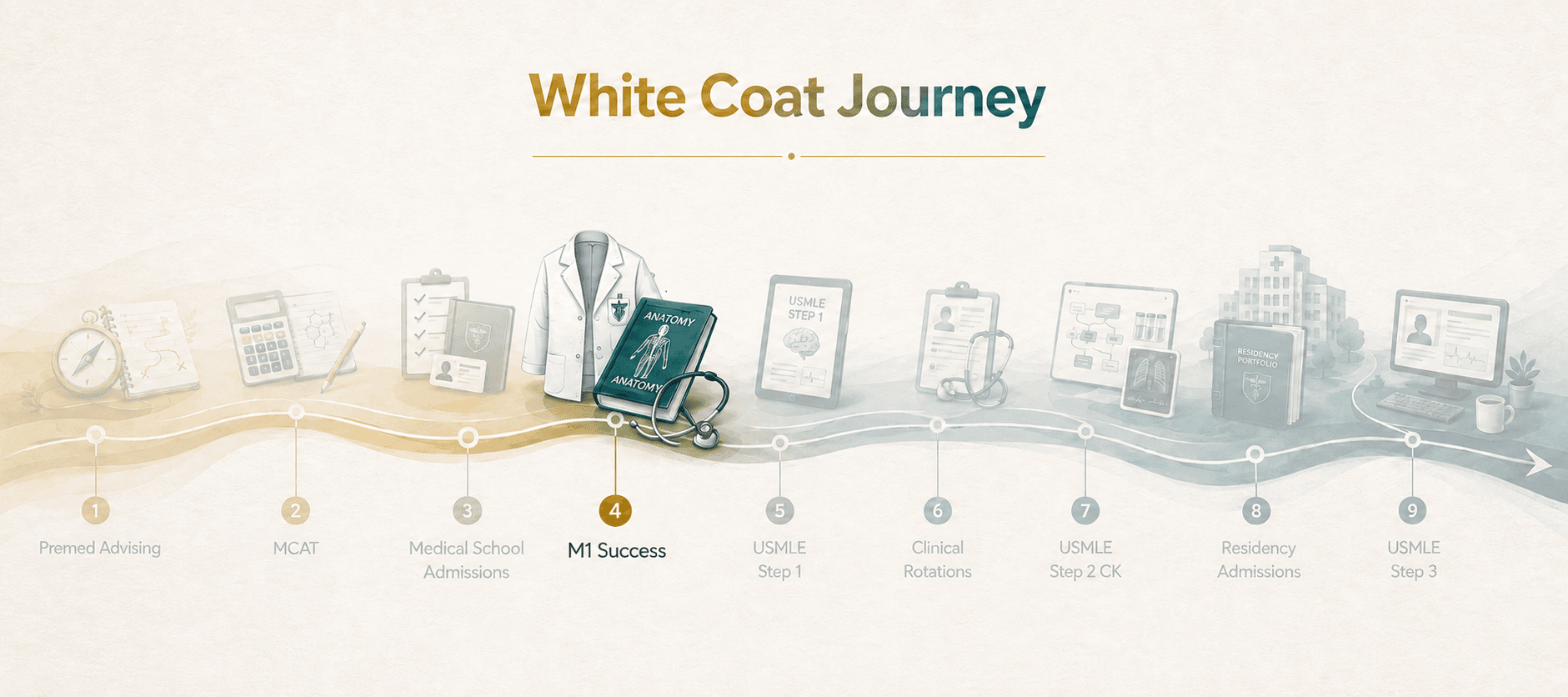
White Coat Journey
DDQX Approach to Starting Medical School
Getting accepted matters. What comes next is a different kind of learning.
Medical school places more content into less time, and the facts makes more sense when you can connect them.
DDQX helps incoming and early medical students prepare for that shift by building a study system, clinical reasoning skills, and responsible use of AI before the pace accelerates.

Students start M1 with habits that work right up until they don't.
In college, you can succeed by reading carefully, reviewing notes, memorizing details, and adding effort before exams. That approach only works when the volume is manageable.
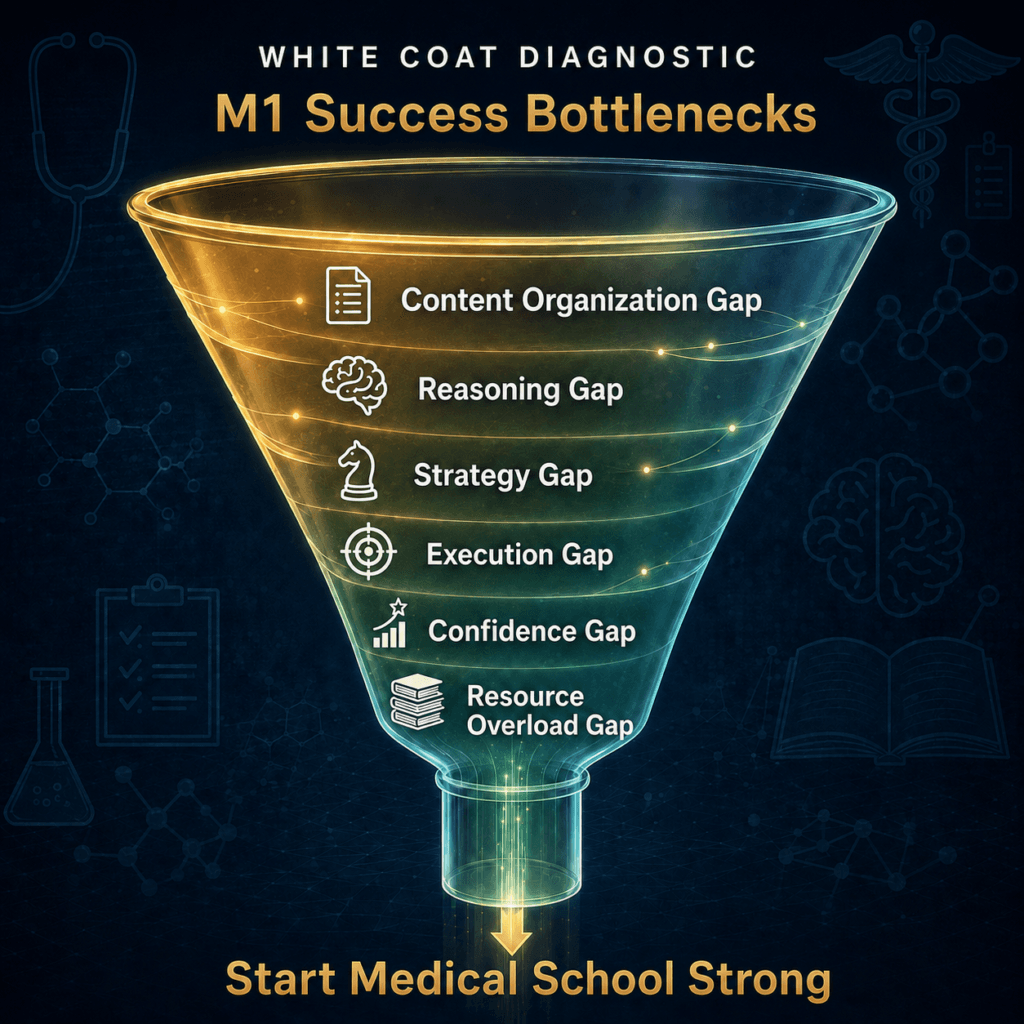
All medical students will struggle with the pace and depth of learning—what varies is the where, why, and how.
If your M1 Success bottleneck is content organization, you may be preparing for medical school by trying to learn more material before classes begin, but the larger issue may be how material is arranged.
This can show up as:
- ➢ Recognizing terms but not being able to explain how they connect
- ➢ Remembering isolated facts without seeing the larger system
- ➢ Studying anatomy, physiology, pathology, and pharmacology as separate silos
- ➢ Feeling productive while pre-studying but unsure what will actually matter later
- ➢ Struggling to move from recognition to recall to clinical application
- ➢ Building a longer study schedule without building a better learning system
The goal is to start medical school with a system for organizing new information as it arrives.
If your M1 Success bottleneck is reasoning, you may be used to succeeding by memorizing well, working hard, and recognizing familiar material.
This can show up as:
- ➢ Understanding a lecture but struggling with application questions
- ➢ Recognizing a flashcard but not being able to explain the mechanism out loud
- ➢ Memorizing details without knowing how to use them in a clinical context
- ➢ Feeling comfortable with content review but less comfortable with problem-solving
- ➢ Struggling to connect basic science to a patient presentation
- Depending on familiarity instead of a repeatable reasoning process
The goal is to move from recognition-based studying toward physician-style reasoning.
If your M1 Success bottleneck is strategy, you may want to prepare well, but it may not yet be clear what deserves your attention before school starts, what should wait, and what would count as a healthy first-month plan.
This can show up as:
- ➢ Studying a little anatomy, physiology, pharmacology, or biochemistry without a clear sequence
- ➢ Starting Anki without knowing how it should fit into your larger study system
- ➢ Watching multiple YouTube channels without knowing what problem each one solves
- ➢ Taking advice from current students without knowing whether it fits your curriculum or learning style
- ➢ Feeling behind before medical school has even started
- ➢ Confusing preparation with trying to pre-learn everything
The goal is to prepare with focus instead of pressure.
If your M1 Success bottleneck is execution, you may have good intentions and reasonable advice, but the preparation may not yet be turning into consistent habits.
This can show up as:
- ➢ Making schedules you do not follow
- ➢ Switching study systems every few days
- ➢ Starting resources without finishing them
- ➢ Knowing you need a review workflow but not having one you can actually use
- ➢ Preparing intensely for a few days and then losing momentum
- ➢ Feeling motivated in theory but inconsistent in practice
The goal is to turn preparation into a practical routine with clear follow-through.
If your M1 Success bottleneck is confidence, you may be entering medical school with the quiet worry that everyone else is more prepared, more disciplined, or more naturally suited for the workload.
This can show up as:
- ➢ Comparing yourself to classmates before school begins
- ➢ Feeling behind even when classes have not started yet
- ➢ Worrying that your past study habits will not be enough
- ➢ Assuming everyone else already knows how to study like a medical student
- ➢ Feeling overwhelmed by Anki, resources, schedules, or advice threads
- ➢ Interpreting normal transition anxiety as proof that you are not ready
The goal is to help you build confidence from structure, not comparison.
If your M1 Success bottleneck is resource overload, you may be surrounded by too many recommendations before classes have even begun.
This can show up as:
- ➢ Saving more resources than you can realistically use
- ➢ Feeling behind because other students seem to know more tools
- ➢ Starting Anki decks without knowing how they should fit into your workflow
- ➢ Watching videos or reading guides without a clear plan for applying them
- ➢ Switching between preparation systems before one has a chance to work
- ➢ Feeling like you are preparing, but becoming more anxious instead of more ready
The goal is to simplify your resource ecosystem so your first semester has structure before it has clutter.
You need new study habits to keep up with medical learning.
Should I study before M1? How do I avoid falling behind? What does a sustainable weekly schedule look like? How do I study for school exams without losing sight of Step 1?
These are the right questions. DDQX gives you a better answer than "just work harder."
- Study plan is built around “getting through” lectures.
- Every topic becomes its own pile of facts.
- Anki feels like the plan instead of a tool in the plan.
- Videos and notes feel productive but retrieval stays weak.
- Missed questions create panic instead of a review process.
- Study plan is built for organized retrieval and application.
- New material connects to learned mechanisms and patterns.
- Anki fits into a broader system for spaced review.
- Review is built into a repeatable weekly rhythm.
- Early misses are feedback for adjusting, not panicking.
DDQX meets your timeline, budget, and need for accountability.
Every pathway tailors guidance to your particular circumstances and passions.
Choose the pathway that helps you reach your desired outcome in the setting you prefer.
Free Resource Hub
Guides, sample cases, and tools to help learners study with more structure and discipline.
Personalized Strategy Reports
Expert-built study plans, admissions feedback, and competitiveness analyses.
1-on-1 Coaching & Tutoring
Personalized, ongoing support for study planning, applications, and exam preparation.
DDQX Courses & Community
Cohort-based, expert-led guidance on achieving your goals with DDQX Learning methods.
M1 Success is the 4th stage in the White Coat Journey.