White Coat Journey
DDQX Learning's Approach to MCAT Preparation
Don't just prepare for a test. Build the reasoning system you'll need as a doctor.
The MCAT tests more than content recall—it determines how well you read under pressure, decide what matters, interpret unfamiliar information, and commit to an answer.
You do not need to memorize your way through every uncertainty. You need a process for deciding what matters.

Most MCAT students are working harder than their score reflects.
You may be watching content videos, reviewing flashcards, completing practice questions, and taking full-length exams, yet still wondering why the score is not moving.
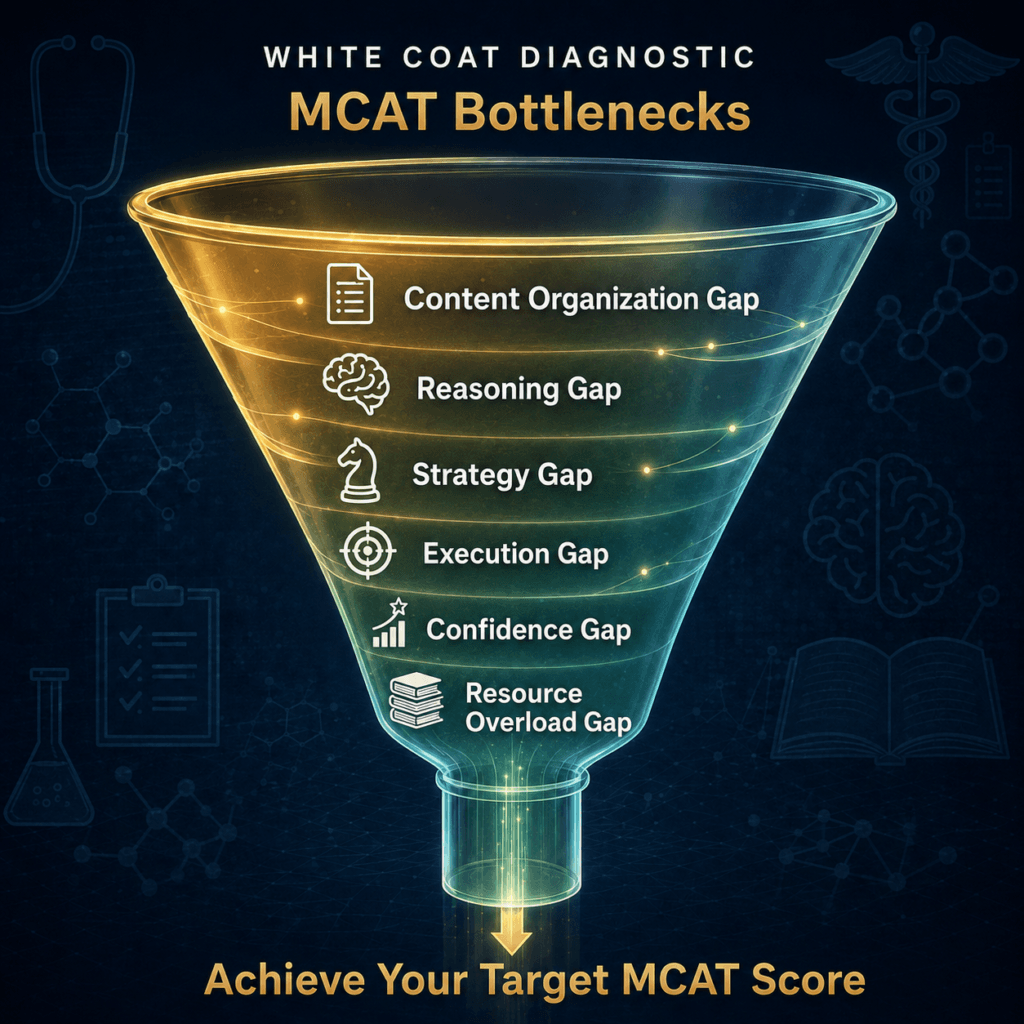
Your score report shows the outcome. It usually does not explain the cause.
If your MCAT bottleneck is content organization, you may be studying a lot, but the information is not yet arranged in a way your brain can use under timed conditions.
This can show up as:
- ➢ Recognizing a topic but not knowing how to apply it
- ➢ Feeling like “I know I studied this” but still missing the question
- ➢ Memorizing details without seeing how they connect
- ➢ Reviewing content repeatedly without clear score movement
- ➢ Struggling to link passage clues to the right concept or choice
The goal is to turn scattered knowledge into a system you can actually use under timed conditions.
If your MCAT bottleneck is reasoning, you may know a fair amount of content, but your score is being limited by how consistently you move from the passage to the question task to the answer choices.
This can show up as:
- ➢ Narrowing to two answers but choosing the wrong one often
- ➢ Overthinking questions that should be more straightforward
- ➢ Missing what the question is actually asking
- ➢ Choosing an answer that sounds familiar but does not fit
- ➢ Getting trapped by attractive answer choices
- ➢ Reviewing explanations but not changing your approach
The goal is to build a more reliable passage-to-answer system.
If your MCAT bottleneck is strategy, you may already be putting in meaningful effort, but your study decisions may not be targeted tightly enough yet.
This can show up as:
- ➢ Bouncing between resources
- ➢ Reviewing questions without a consistent error system
- ➢ Spending too much time on low-yield activities
- ➢ Taking full-length exams without translating the results into a concrete adjustment to your plan
The goal is to make a plan that aligns your goal score and exam date with sufficient time to address content gaps, pacing issues, and your most common miss patterns.
If your MCAT bottleneck is execution, you may understand what you should be doing, but the plan is not consistently turning into completed work, reviewed blocks, corrected patterns, or measurable score movement.
This can show up as:
- ➢ Having a reasonable study plan on paper but not completing it
- ➢ Falling behind on question blocks, review, or full-length exams
- ➢ Studying in bursts instead of following a repeatable rhythm
- ➢ Knowing what went wrong but not changing what you do
- ➢ Struggling with pacing, endurance, or test-day routines
- ➢ Feeling busy without seeing clear progress in your score data
The goal is to turn your plan into a repeatable weekly system with clearer feedback loops.
If your MCAT bottleneck is confidence, you may be more capable than your current test behavior shows.
This can show up as:
- ➢ Abandoning your first instinct even when it was well-reasoned
- ➢ Over-thinking choices until you talk yourself out of the answer
- ➢ Spending too much time on questions because of uncertainty
- ➢ Interpreting normal uncertainty as proof you’re unprepared
- ➢ Changing answers late without a clear reason
- ➢ Letting one difficult passage affect the rest of the section
The goal is to rebuild trust in your process while still being honest about what needs work.
If your MCAT bottleneck is resource overload, you may have too many tools competing for your attention.
This can show up as:
- ➢ Constantly switching between resources
- ➢ Feeling behind because every resource has more to complete
- ➢ Starting new study plans before finishing the current one
- ➢ Using weak scores as proof that you need another tool
- ➢ Spending more time organizing resources than using them
- ➢ Uncertainty on which resource should guide your studying
The goal is to simplify your system so each resource has a purpose and your progress becomes easier to measure.
More resources only help when each one has a clear job.
When resource overload happens, every missed question can feel like proof that you need another tool, or video series, or flashcard deck, or question bank, or... something!
DDQX Learning helps you move from resource accumulation to resource assignment.
- Constantly switching resources
- Feeling behind in every system
- Restarting study plans repeatedly
- Reviewing questions without changing behavior
- Taking full-lengths without knowing what to fix next
- Each resource has a defined job
- Your weekly plan has fewer moving parts
- Missed questions are classified by failure point
- Practice data determines what changes next
- Your MCAT plan fits your application timeline
Once you know the bottleneck, you need a way through it.
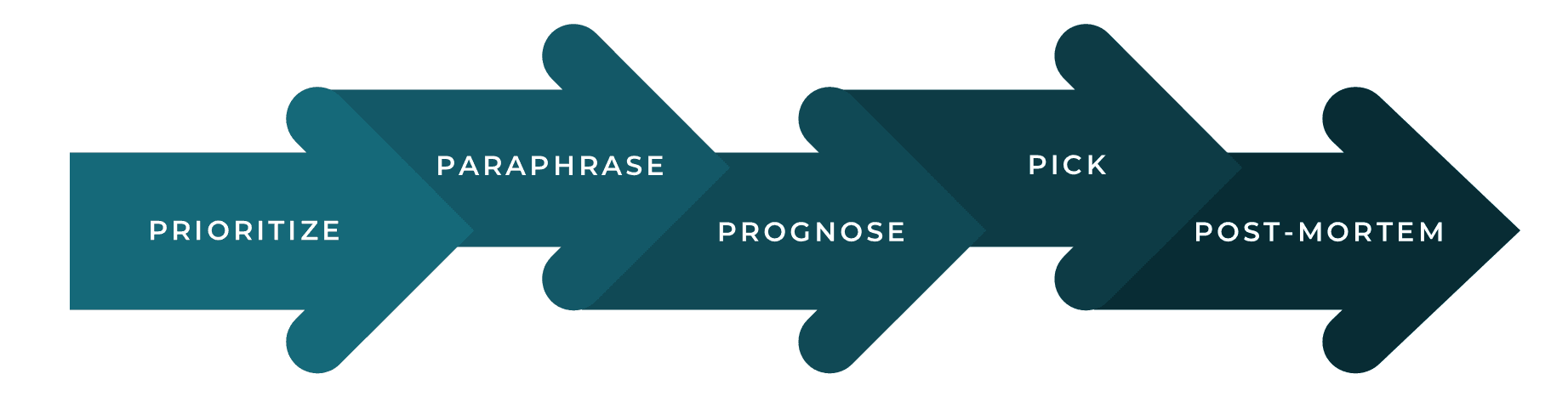
The 5P Approach™ makes tackling MCAT passages more structured and content review more useful because it ties what you know to the decision you have to make right now.
DDQX meets your timeline, budget, and need for accountability.
Every pathway tailors guidance to your particular circumstances and passions.
Choose the pathway that helps you reach your desired outcome in the setting you prefer.
Free Resource Hub
Guides, sample cases, and tools to help learners study with more structure and discipline.
Personalized Strategy Reports
Expert-built study plans, admissions feedback, and competitiveness analyses.
1-on-1 Coaching & Tutoring
Personalized, ongoing support for study planning, applications, and exam preparation.
DDQX Courses & Community
Cohort-based, expert-led guidance on achieving your goals with DDQX Learning methods.
MCAT is the 2nd stage in the White Coat Journey.
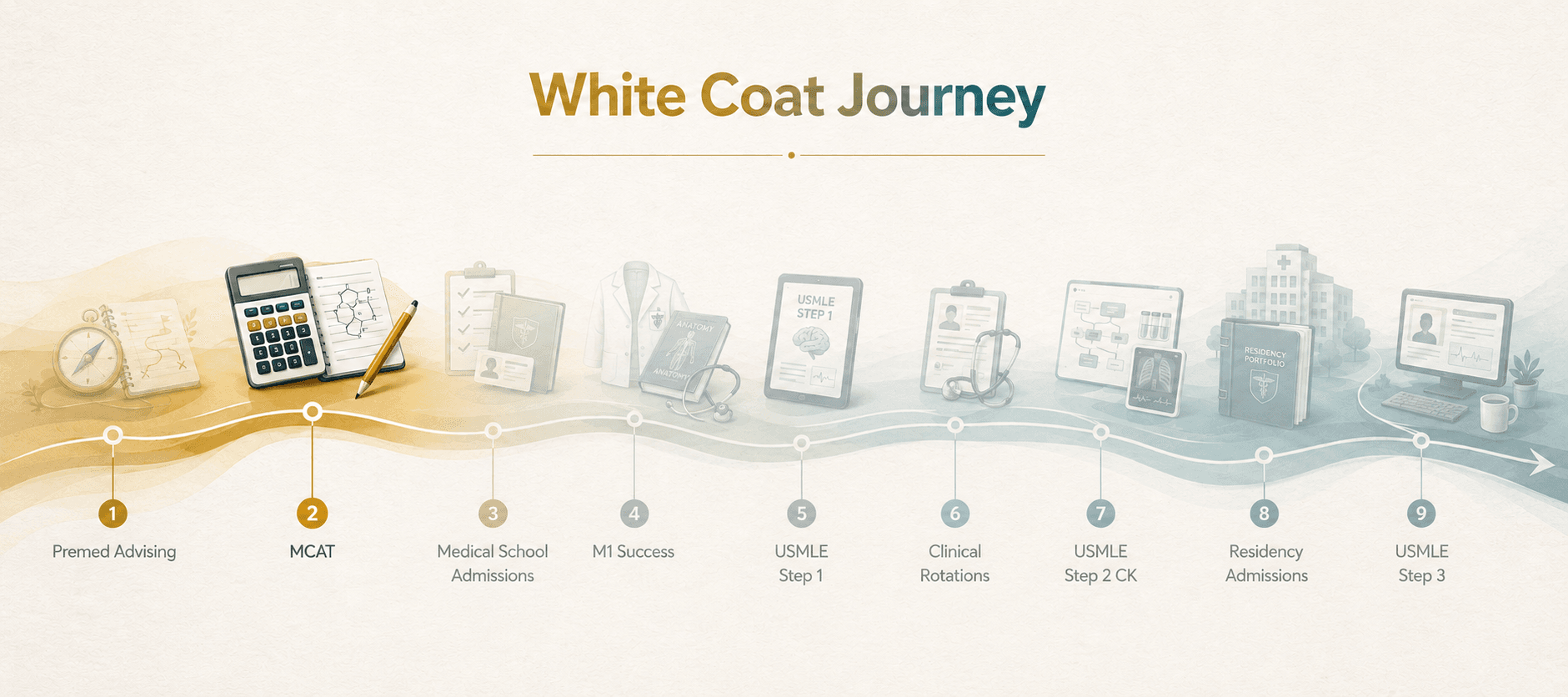
If you are preparing for the MCAT now, focus on building a score-growth system. If your exam is behind you, the next step is turning your experiences, MCAT performance, and motivation into a coherent medical school application.
MCAT — Frequently Asked Questions
How is DDQX MCAT coaching different from ordinary MCAT tutoring?
Most MCAT tutoring starts with missed content. DDQX starts with the pattern behind the miss. A student may miss a question because of a content gap, a passage-reading error, a timing problem, premature answer selection, weak elimination discipline, or a poor post-test review process. Those problems require different fixes. DDQX coaching is built around diagnosing the real bottleneck first, then building a plan around the next problem worth solving.
What happens during an MCAT Strategy Consult?
The consult is a diagnostic conversation. We look at where you are now, where your score needs to be, what you have already tried, and what keeps breaking down. That may include your full-length score pattern, section-by-section trends, CARS performance, science passage reasoning, timing, resource use, study schedule, and test-day risk. The goal is to leave with a clearer working diagnosis of your score gap and a practical next step.
Why do my MCAT scores stay inconsistent even when I study a lot?
Inconsistent scores often mean the issue is deeper than effort. Many students keep adding content review without building a stable process for reading passages, identifying the question task, predicting the answer, and eliminating mismatches. DDQX uses a passage-to-reasoning workflow adapted from the 5P Approach: prioritize the clues, paraphrase the task, prognose the likely answer, pick with discipline, and post-mortem the error. That gives each practice block a purpose beyond checking whether you got the question right.
Can DDQX help with CARS?
Yes. CARS coaching focuses on passage reasoning, author logic, question-task recognition, timing, and answer-choice elimination. Many students treat CARS as a reading-speed problem. Sometimes speed matters, but the larger issue is often interpretation under pressure. DDQX helps students slow down the right parts of the process so they can move faster through the parts that do not deserve as much attention.
Do you teach science content or mainly strategy?
Both, depending on what the score pattern shows. Some students need targeted review in biology, biochemistry, chemistry, physics, psychology, or sociology. Others know the content but lose points when the concept appears inside a dense passage. DDQX coaching connects content review to passage execution so students are not just relearning facts in isolation.
How do you review full-length exams?
A full-length review should do more than count wrong answers. We classify misses by cause: content gap, passage misread, question-task error, weak prediction, answer-choice trap, timing pressure, fatigue, or second-guessing. That classification turns a score report into a study plan. It also helps students stop spending equal time on every mistake when only a few patterns may be driving most of the score loss.
How many hours of MCAT coaching do I need?
It depends on the distance between your current score and goal score, your timeline, your section pattern, and how clear the underlying problem is. A student with one section weakness may need a short targeted plan. A student with unstable full-lengths, poor timing, and resource overload may need ongoing coaching through multiple practice-test cycles. DDQX begins by identifying the problem first, then matching the level of support to the work required.
Do you guarantee an MCAT score increase?
No responsible coaching program should guarantee a score outcome. MCAT performance depends on baseline preparation, timeline, practice quality, consistency, test-day conditions, and how well the student executes the plan. DDQX offers a clearer diagnosis, a more disciplined review process, and coaching designed to help students reason more effectively under pressure. The work is structured, but the outcome still has to be earned.