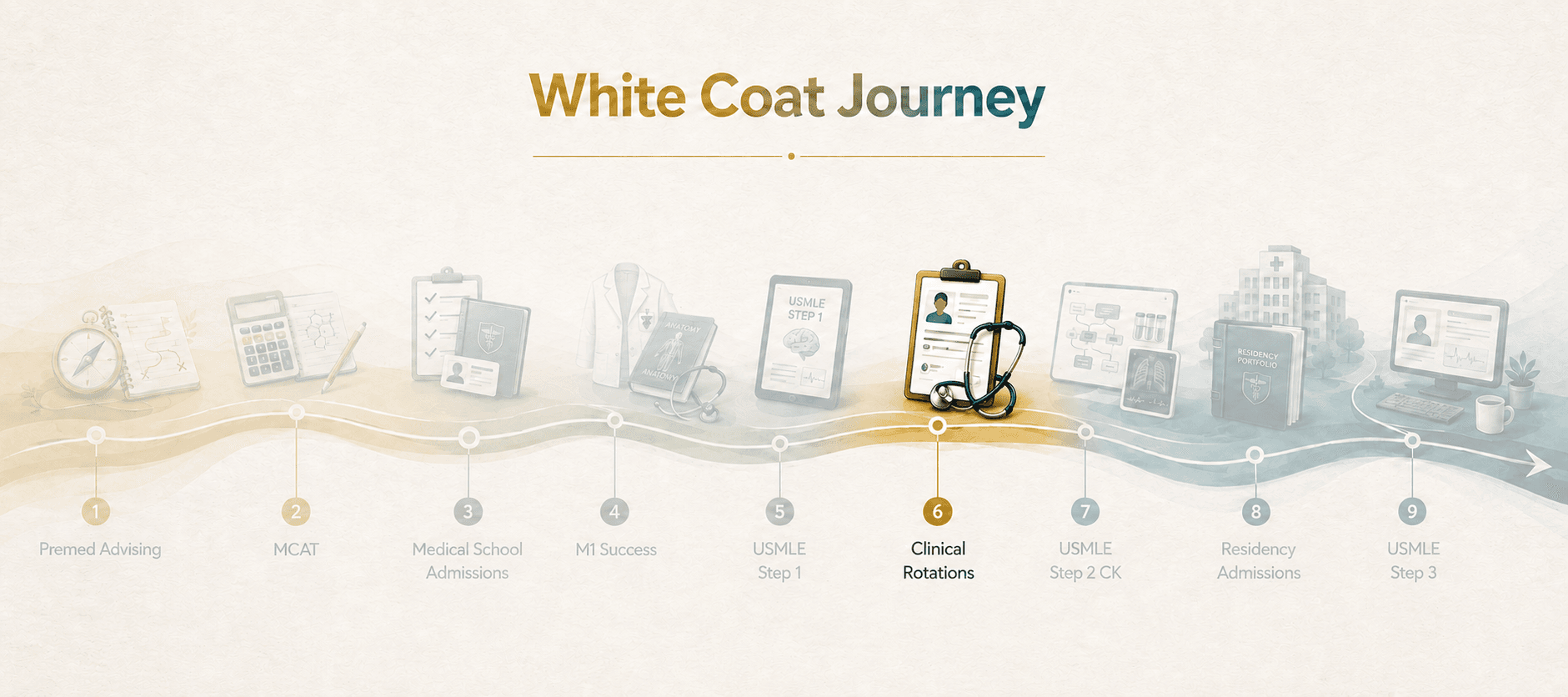
White Coat Journey
DDQX Learning's Approach to Clinical Rotations
Build the clinical reasoning system you need on the wards.
Clinical rotations ask for a skill medical school rarely teaches directly: using patient information to think, speak, write, and act clinically.
DDQX helps students move from exam-based learning into patient-based reasoning.

Rotations can make capable students feel uncertain in a new way.
Preclinical learning usually gives you a defined target: a lecture, a block exam, a question bank, a known list of topics. Rotations are different. The target keeps moving.
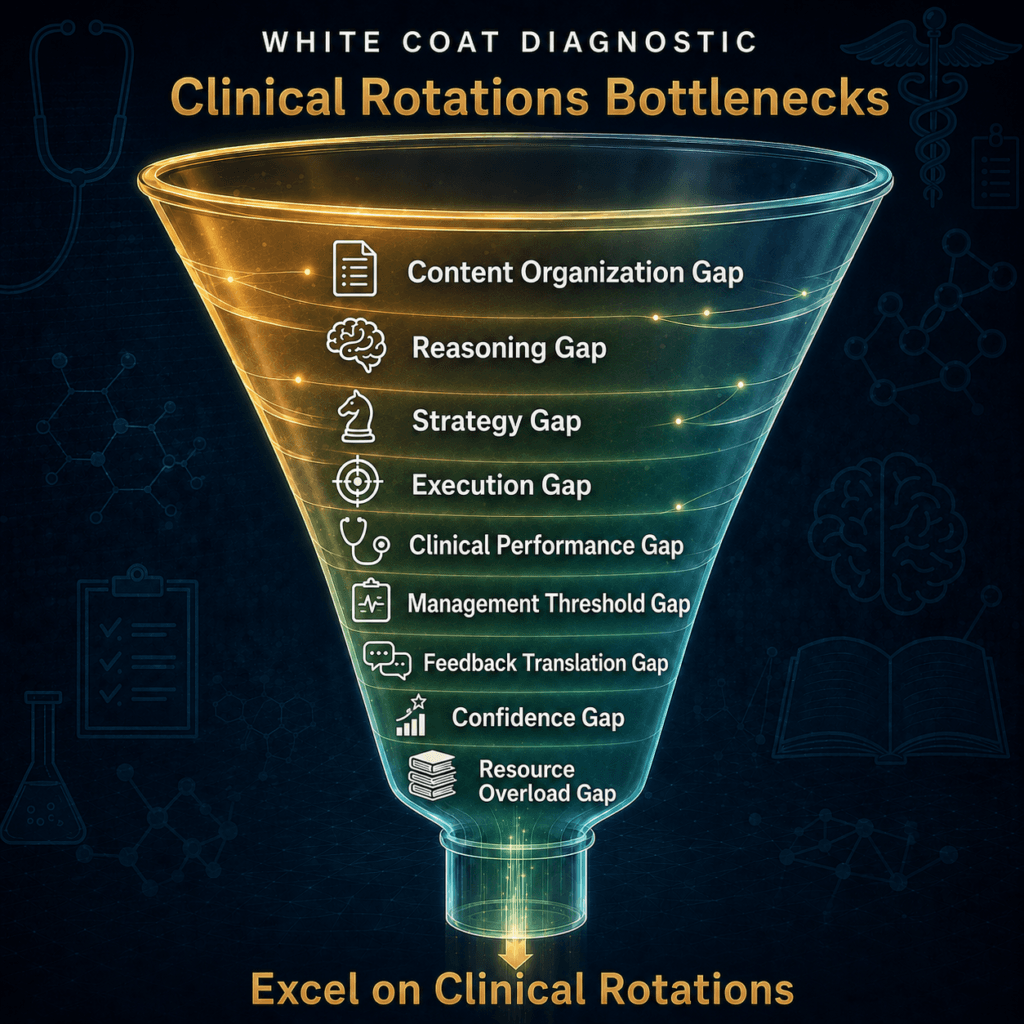
Clinical rotations expose the gap between knowing information and applying it in a clinical context.
If your clinical rotations bottleneck is content organization, you may know more than you are able to show on the wards right now.
This can show up as:
- ➢ Oral presentations that include many facts but lack a clear clinical direction
- ➢ SOAP notes that describe information without prioritizing active problems
- ➢ Assessments that feel like summaries instead of interpretations
- ➢ Plans that are not clearly linked to the problem list
- ➢ Difficulty deciding which details matter most for rounds
- ➢ Shelf studying that feels disconnected from real patient care
The goal is to organize patient information so your team can understand what you think is happening, why it matters, and what should happen next.
If your clinical rotations bottleneck is reasoning, you may be able to collect information and recognize common diagnoses, but the harder step is turning the patient’s story into a prioritized differential, a leading diagnosis, and a defensible next step.
This can show up as:
- ➢ Listing possible diagnoses without ranking them by likelihood or danger
- ➢ Presenting patient details without clearly stating what you think is happening
- ➢ Struggling to decide what matters most for rounds
- ➢ Feeling unsure which finding changes management
- ➢ Knowing facts from preclinical learning but having trouble applying them to real patients
- ➢ Waiting for the team to interpret the case instead of offering your own assessment
The goal is to help you reason through patients more like a clinician and less like a student trying to remember every detail.
If your clinical rotations bottleneck is strategy, you may be working hard, but your rotation plan may not yet be matched to what the clerkship is actually asking of you.
Clinical rotations require several overlapping skills at once:
- ➢ Patient care participation
- ➢ Oral presentations
- ➢ SOAP notes
- ➢ Shelf preparation
- ➢ Team communication
- ➢ Feedback use
- ➢ Professional reliability
- ➢ Clinical reasoning
The goal is to build a rotation-specific plan that balances clinical performance with shelf readiness.
If your clinical rotations bottleneck is execution, you may understand what you should be doing, but the daily system may not yet be consistent enough.
This can show up as:
- ➢ Delayed notes
- ➢ Incomplete patient follow-up
- ➢ Inconsistent shelf study
- ➢ Missed opportunities to ask for feedback
- ➢ Difficulty converting each patient encounter into a learning point
- ➢ Long clinical days that do not produce a clear plan for improvement
The goal is to convert good intentions into a workable daily rotation rhythm.
If your clinical rotations bottleneck is clinical performance, you may be learning, but the way that learning appears to the team may not yet reflect your ability.
This can show up as:
- ➢ Presentations that do not clearly communicate your assessment
- ➢ Patient ownership that feels inconsistent or incomplete
- ➢ Notes that include information but do not show clear clinical thinking
- ➢ Difficulty knowing when or how to contribute during rounds
- ➢ Follow-through that is not yet reliable enough for the team to trust
- ➢ Communication that feels too hesitant, too vague, or poorly timed
The goal is to help your day-to-day performance more accurately show your clinical growth.
If your clinical rotations bottleneck is a management threshold gap, you may be able to identify the likely diagnosis, but the next-step decision may still feel unstable.
This can show up when you are deciding whether a patient needs:
- ➢ Reassurance
- ➢ Outpatient follow-up
- ➢ Additional testing
- ➢ Admission
- ➢ Urgent treatment
- ➢ Consultation
- ➢ Escalation of care
The goal is to help you connect clinical patterns to management urgency and next-step decision-making.
If your clinical rotations bottleneck is feedback translation, you may be receiving clinical feedback that is brief, indirect, inconsistent, or phrased in general terms.
This can sound like:
- ➢ “Be more concise.”
- ➢ “Read more.”
- ➢ “Take more ownership.”
- ➢ “Work on your assessment.”
- ➢ “Be more proactive.”
- ➢ “Keep working on your presentations.”
The goal is to turn vague feedback into specific behaviors you can apply on the next shift or clinic day.
If your clinical rotations bottleneck is confidence, you may be more capable than you feel, but the clinical environment may be making uncertainty louder.
This can show up as:
- ➢ Staying quiet even when you have a reasonable thought
- ➢ Over-apologizing when you are corrected
- ➢ Avoiding presentations or minimizing your role in them
- ➢ Hesitating to propose an assessment or plan
- ➢ Assuming every correction means you are failing
- ➢ Comparing yourself to classmates, residents, or students at different points in training
The goal is to help you participate more steadily while continuing to learn safely.
If your clinical rotations bottleneck is resource overload, you may be trying to manage too many inputs at once.
This can show up as:
- ➢ Feeling busy all the time but unsure what is actually improving
- ➢ Switching shelf resources without a clear reason
- ➢ Trying to follow every resident’s preference equally
- ➢ Using patient-care tools and shelf tools without knowing which should guide the day
- ➢ Collecting feedback from multiple people without turning it into a plan
- ➢ Feeling pulled between clinical responsibilities and exam preparation
The goal is to simplify your rotation system so your tools support clinical reasoning, patient care, and shelf preparation without overwhelming you.
The real shift is from question-bank logic to patient-care logic.
In a question bank, the case was written so one answer is best.
On rotations, the patient was not written for you.
The data is incomplete. The story changes. The chart is messy.
DDQX Learning helps you move from practice questions to actual patient care.
- Collecting patient data without knowing what matters most
- Presenting facts without a clear problem representation
- Building differentials that are too broad or too narrow
- Struggling to connect the assessment to the plan
- Waiting for vague feedback instead of seeking advice
- Treating shelf prep and clinical work as separate tasks
- Finish cases without capturing the transferable lesson
- Key findings are prioritized before you present
- Patient stories are organized into concise presentations
- Differentials are focused enough to guide clinical decisions
- Assessments lead logically into practical plans
- Feedback becomes a specific behavior to practice next
- Patient encounters reinforce shelf-relevant reasoning
- Each case produces a lesson you can apply to future patients
DDQX meets your timeline, budget, and need for accountability.
Every pathway tailors guidance to your particular circumstances and passions.
Choose the pathway that helps you reach your desired outcome in the setting you prefer.
Free Resource Hub
Guides, sample cases, and tools to help learners study with more structure and discipline.
Personalized Strategy Reports
Expert-built study plans, admissions feedback, and competitiveness analyses.
1-on-1 Coaching & Tutoring
Personalized, ongoing support for study planning, applications, and exam preparation.
DDQX Courses & Community
Cohort-based, expert-led guidance on achieving your goals with DDQX Learning methods.
Clinical Rotations is the 6th stage in the White Coat Journey.