White Coat Journey
DDQX Learning's Approach to USMLE Step 1
Build a Step 1 pass plan around how medicine actually works.
Facts matter. So does the structure that helps you use those facts when the question changes the surface details.
DDQX helps Step 1 learners move from scattered review to organized reasoning, with a plan built around mechanism, question performance, NBME data, and transfer.

Step 1 makes prepared students feel disorganized.
You may be using UWorld, Anki, First Aid, Pathoma, Boards & Beyond, Sketchy, school lectures, and NBMEs. Each resource can help. Together, they can also become clutter.
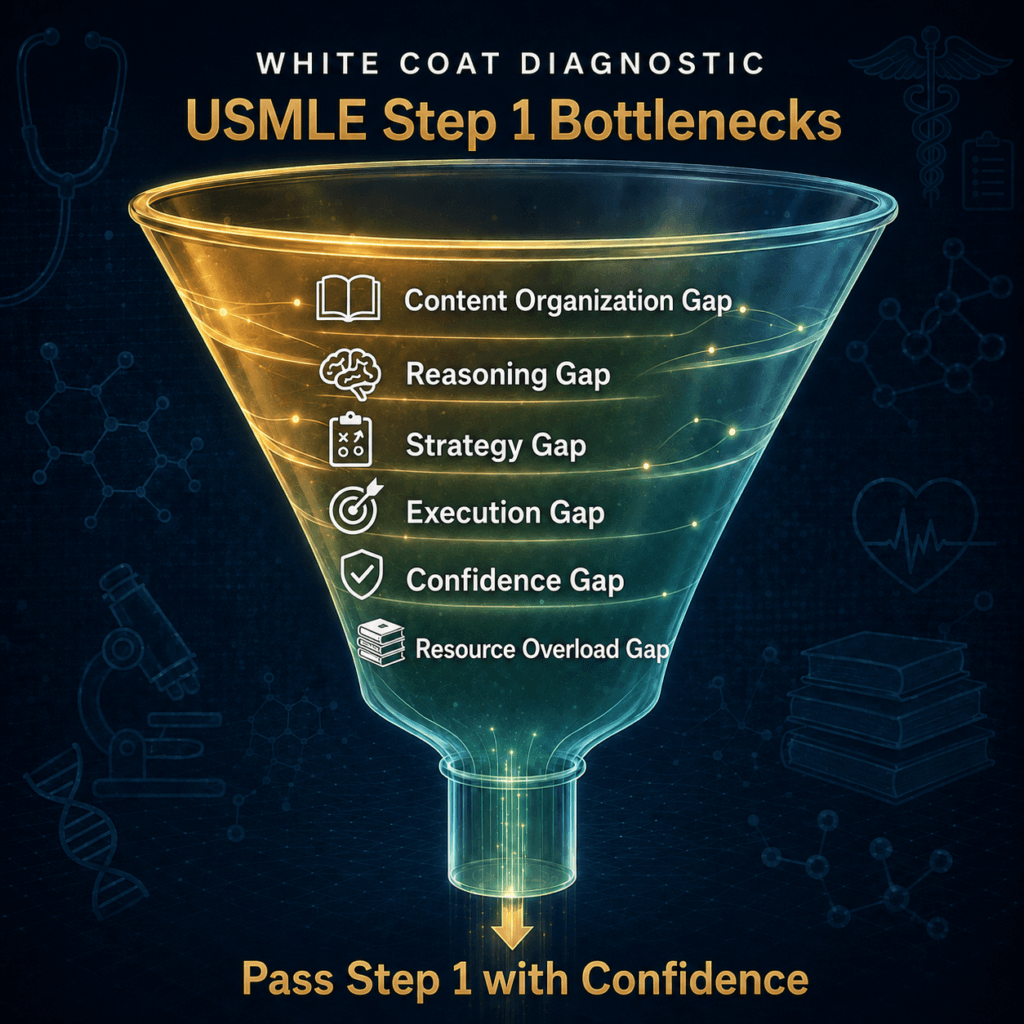
At some point, the problem is no longer finding another resource, but making the resources you have work together.
If your Step 1 bottleneck is content organization, you may have studied a large amount of material, but the information may not yet be arranged in a way that helps you use it on NBME-style questions.
This can show up as:
- ➢ Recognizing the topic but not knowing what the stem is really testing
- ➢ Remembering scattered facts without seeing the larger mechanism
- ➢ Studying systems or subjects in isolation
- ➢ Missing questions that combine physiology, pathology, pharmacology, and clinical presentation
- ➢ Feeling like facts are familiar but not usable under test conditions
- ➢ Reviewing content repeatedly without seeing enough improvement in question performance
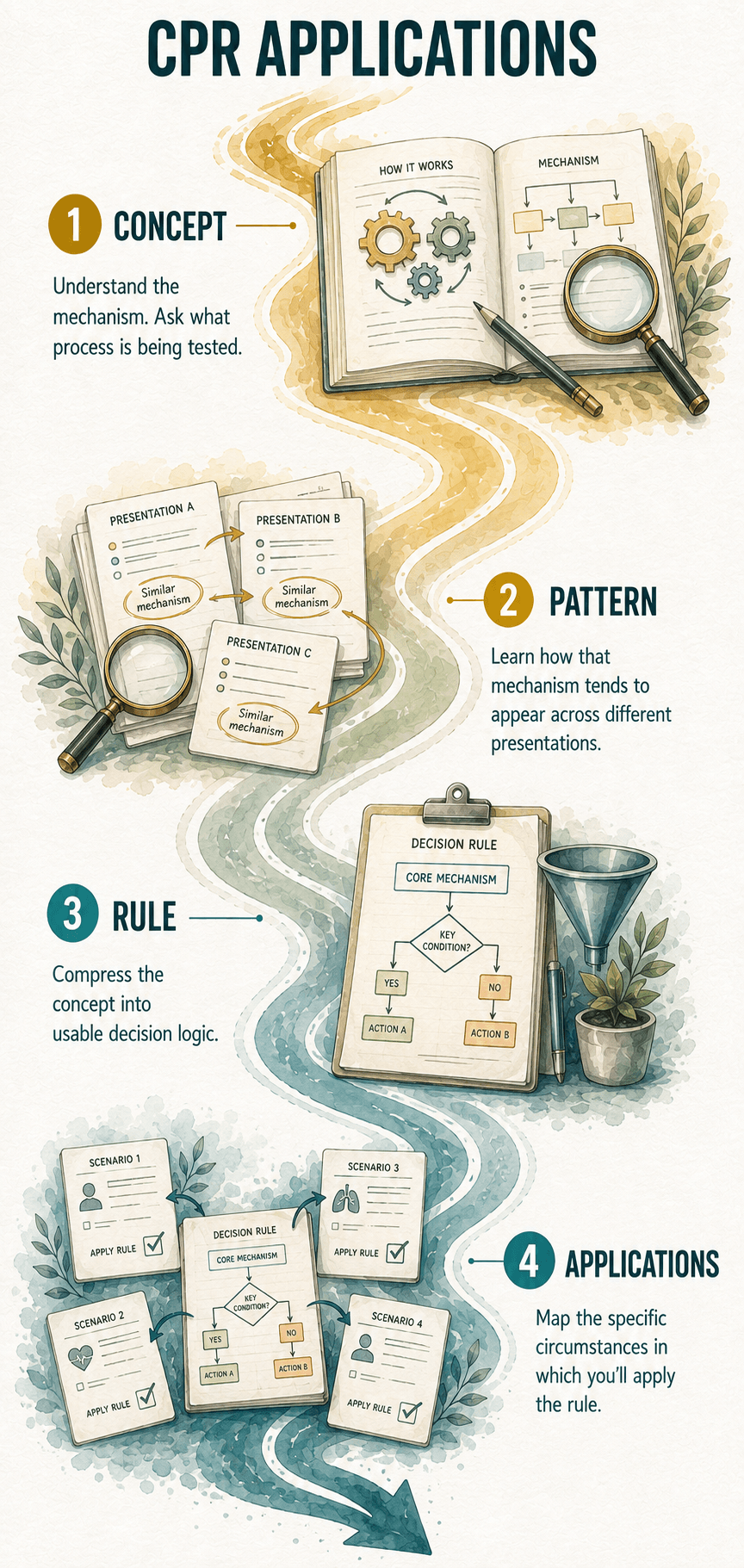
The goal is to help facts stop feeling random by sorting them into mechanisms, patterns, rules, and clinical applications.
If your Step 1 bottleneck is reasoning, you may know enough content to recognize the general subject area, but the question may still break down when you have to identify the mechanism, choose between two plausible answers, or apply a familiar concept in an unfamiliar presentation.
This can show up as:
- ➢ Thinking “I knew this” after reviewing the explanation
- ➢ Narrowing to two answers and choosing the wrong one
- ➢ Picking the answer that sounds most familiar
- ➢ Recognizing the disease but missing the mechanism being tested
- ➢ Memorizing facts without knowing what they predict
- ➢ Struggling when a familiar concept appears in a new vignette
The goal is to strengthen mechanism-to-application reasoning and reduce avoidable two-answer misses.
If your Step 1 bottleneck is strategy, you may be studying, doing questions, and reviewing resources, but the overall plan may not yet be matched to your actual risk.
This can show up as:
- ➢ Treating every missed question as a content gap
- ➢ Taking NBMEs without a clear interpretation plan
- ➢ Adding more resources before identifying the reason for a plateau
- ➢ Reviewing question explanations without changing the next study decision
- ➢ Spending too much time on low-yield review while higher-risk patterns remain unaddressed
- ➢ Feeling busy but unsure whether your plan is improving your pass readiness
The goal is to identify the highest-yield next move instead of spending more weeks on unfocused effort.
If your Step 1 bottleneck is execution, you may have a reasonable plan, but the plan may not be consistently turning into completed blocks, reviewed misses, corrected rules, mixed review, and measurable progress.
This can show up as:
- ➢ Unfinished schedules
- ➢ Irregular question review
- ➢ Inconsistent NBME follow-up
- ➢ Study days that feel busy but do not change performance
- ➢ Repeating the same miss patterns across blocks
- ➢ Writing vague review notes that do not guide the next study decision
The goal is to build a weekly execution rhythm that produces feedback, not just hours.
If your Step 1 bottleneck is confidence, you may understand more than your test behavior shows, but pressure may be changing how you read stems, choose answers, or respond to uncertainty.
This can show up as:
- ➢ Changing correct answers without a clear reason
- ➢ Over-reading clues that were meant to be straightforward
- ➢ Distrusting your first interpretation of the vignette
- ➢ Interpreting every miss as proof that you are not ready
- ➢ Spending too much time trying to feel certain
- ➢ Letting one difficult block affect the next block or study day
The goal is to rebuild trust in your process while still being honest about what needs correction.
If your Step 1 bottleneck is resource overload, you may have too many inputs competing for attention.
This can show up as:
- ➢ Switching resources whenever your score feels stuck
- ➢ Feeling productive because you are using many tools
- ➢ Struggling to decide which resource should guide your next study decision
- ➢ Adding more videos, cards, or notes before identifying the actual problem
- ➢ Comparing your plan to classmates or online schedules
- ➢ Spending more time managing resources than correcting miss patterns
The goal is to simplify your Step 1 ecosystem so your resources support one coherent pass plan.
A common hidden problem is knowledge transfer.
Many Step 1 students know more than their question blocks show. They can recognize a concept during review but struggle to apply it when the vignette changes the presentation, hides the mechanism, or asks from a different angle.
DDQX Learning helps you move from knowing information to applying it clinically.
- Memorizing facts without understanding the mechanism
- Learning pathology without linking it to normal physiology
- Knowing drug names without understanding mechanisms
- Reading explanations without extracting a usable rule
- Treating every missed question as a content gap
- Mechanisms organize the facts
- Pathology connects back to normal physiology
- Drugs are understood by the problems they solve
- Explanations become reusable decision rules
- Missed questions are classified by the true failure point
Pair CPR Applications™ with the 5P Approach™ for mastery.
Use CPR Applications when studying to give your knowledge structure:
Then use the DDQX 5P Approach™ to accurately apply your knowledge under pressure and meaningful review your practice questions with a post-mortem:
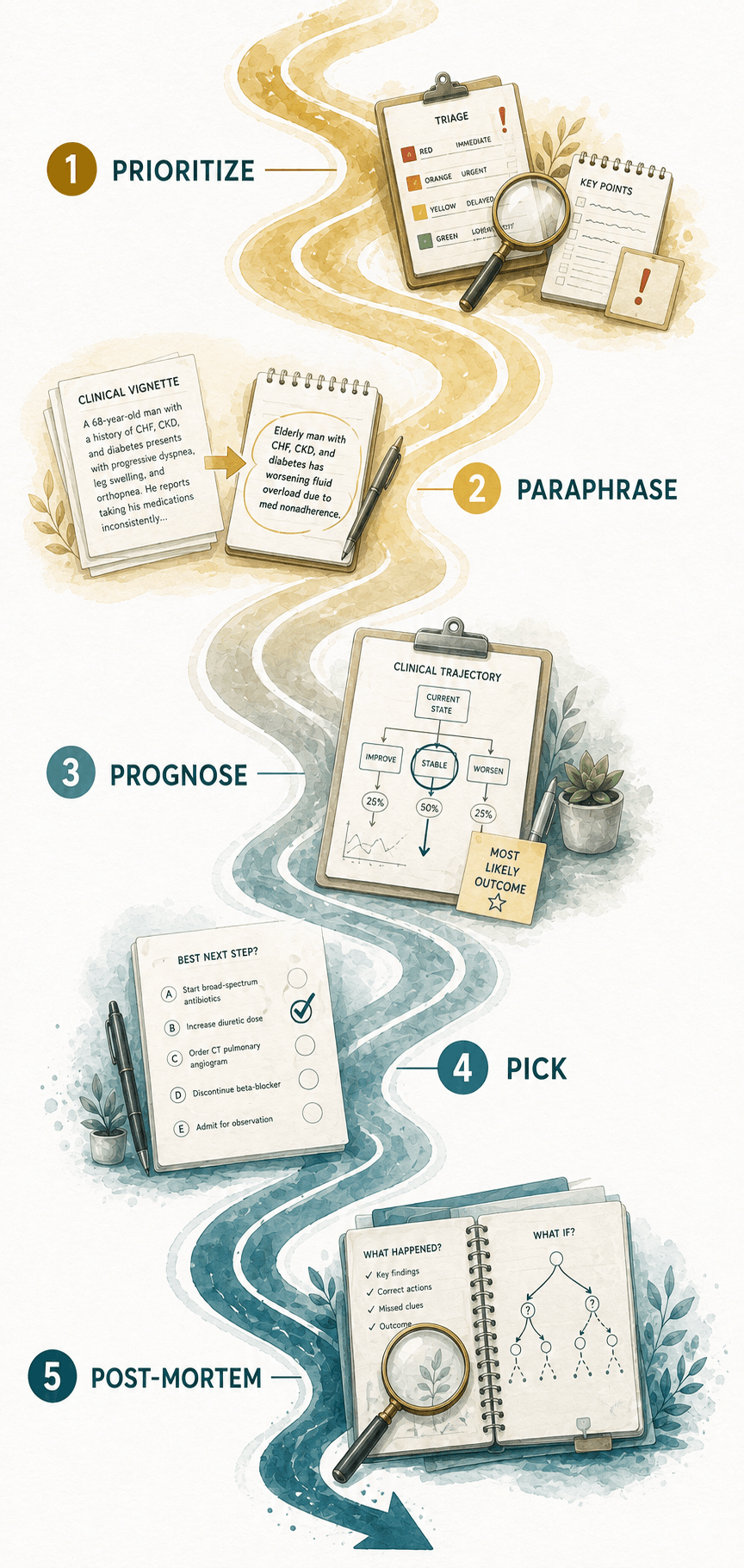
DDQX trains you to treat practice questions like patients now
so you don't try to treat patients like practice questions later.
DDQX meets your timeline, budget, and need for accountability.
Every pathway tailors guidance to your particular circumstances and passions.
Choose the pathway that helps you reach your desired outcome in the setting you prefer.
Free Resource Hub
Guides, sample cases, and tools to help learners study with more structure and discipline.
Personalized Strategy Reports
Expert-built study plans, admissions feedback, and competitiveness analyses.
1-on-1 Coaching & Tutoring
Personalized, ongoing support for study planning, applications, and exam preparation.
DDQX Courses & Community
Cohort-based, expert-led guidance on achieving your goals with DDQX Learning methods.
USMLE Step 1 is the 5th stage in the White Coat Journey.
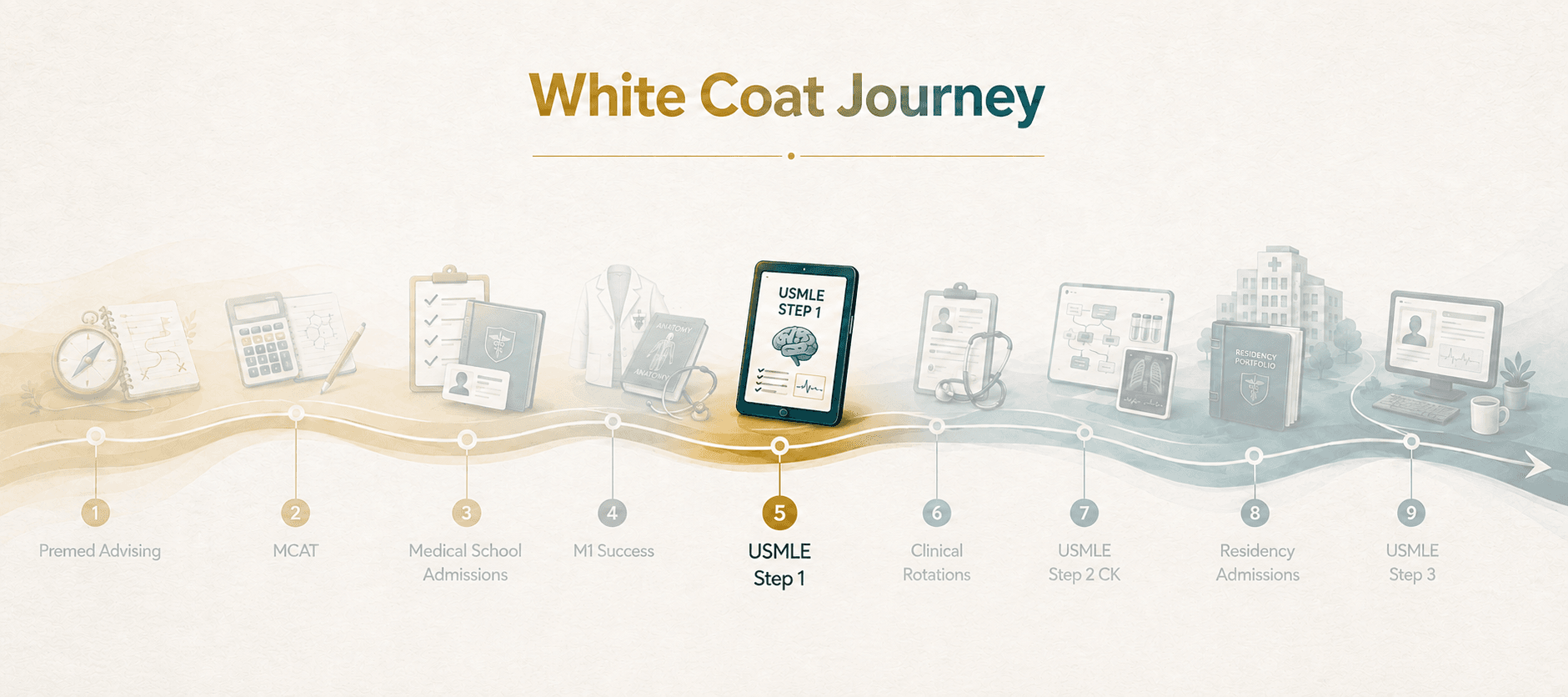
Step 1 sits between early medical school and clinical rotations. It is where foundational science has to become organized enough to support clinical judgment.
After Step 1, the next transition is clinical rotations, where the same reasoning habits show up in presentations, differentials, SOAP notes, shelf exams, and patient care.
USMLE Step 1 — Frequently Asked Questions
Is Step 1 coaching only for students who are failing NBMEs?
Most MCAT tutoring starts with missed content. DDQX starts with the pattern behind the miss. A student may miss a question because of a content gap, a passage-reading error, a timing problem, premature answer selection, weak elimination discipline, or a poor post-test review process. Those problems require different fixes. DDQX coaching is built around diagnosing the real bottleneck first, then building a plan around the next problem worth solving.
Can DDQX guarantee that I pass Step 1?
The consult is a diagnostic conversation. We look at where you are now, where your score needs to be, what you have already tried, and what keeps breaking down. That may include your full-length score pattern, section-by-section trends, CARS performance, science passage reasoning, timing, resource use, study schedule, and test-day risk. The goal is to leave with a clearer working diagnosis of your score gap and a practical next step.
How close to my exam can I start?
Inconsistent scores often mean the issue is deeper than effort. Many students keep adding content review without building a stable process for reading passages, identifying the question task, predicting the answer, and eliminating mismatches. DDQX uses a passage-to-reasoning workflow adapted from the 5P Approach: prioritize the clues, paraphrase the task, prognose the likely answer, pick with discipline, and post-mortem the error. That gives each practice block a purpose beyond checking whether you got the question right.
What happens first?
Yes. CARS coaching focuses on passage reasoning, author logic, question-task recognition, timing, and answer-choice elimination. Many students treat CARS as a reading-speed problem. Sometimes speed matters, but the larger issue is often interpretation under pressure. DDQX helps students slow down the right parts of the process so they can move faster through the parts that do not deserve as much attention.
Do I have to stop using UWorld, Anki, First Aid, Pathoma, Sketchy, or Bootcamp?
Both, depending on what the score pattern shows. Some students need targeted review in biology, biochemistry, chemistry, physics, psychology, or sociology. Others know the content but lose points when the concept appears inside a dense passage. DDQX coaching connects content review to passage execution so students are not just relearning facts in isolation.
What if my main issue is anxiety or confidence?
A full-length review should do more than count wrong answers. We classify misses by cause: content gap, passage misread, question-task error, weak prediction, answer-choice trap, timing pressure, fatigue, or second-guessing. That classification turns a score report into a study plan. It also helps students stop spending equal time on every mistake when only a few patterns may be driving most of the score loss.
What if I have already failed Step 1?
It depends on the distance between your current score and goal score, your timeline, your section pattern, and how clear the underlying problem is. A student with one section weakness may need a short targeted plan. A student with unstable full-lengths, poor timing, and resource overload may need ongoing coaching through multiple practice-test cycles. DDQX begins by identifying the problem first, then matching the level of support to the work required.
Is CPR Applications a replacement for First Aid or UWorld?
No responsible coaching program should guarantee a score outcome. MCAT performance depends on baseline preparation, timeline, practice quality, consistency, test-day conditions, and how well the student executes the plan. DDQX offers a clearer diagnosis, a more disciplined review process, and coaching designed to help students reason more effectively under pressure. The work is structured, but the outcome still has to be earned.