White Coat Journey
DDQX Learning's Approach to Premed Advising
You build the foundations of physician readiness well before the application.
You know medicine is in your future, but may be unsure what to do right now to move toward it intelligently.
Premed advising at DDQX Learning helps you turn a broad goal into a practical plan, so you can make decisions with confidence.

Being Premed can feel like one very long checklist.
The problem with treating premed as a checklist is that every decision affects the others. Good advising helps you see those connections before they become problems.
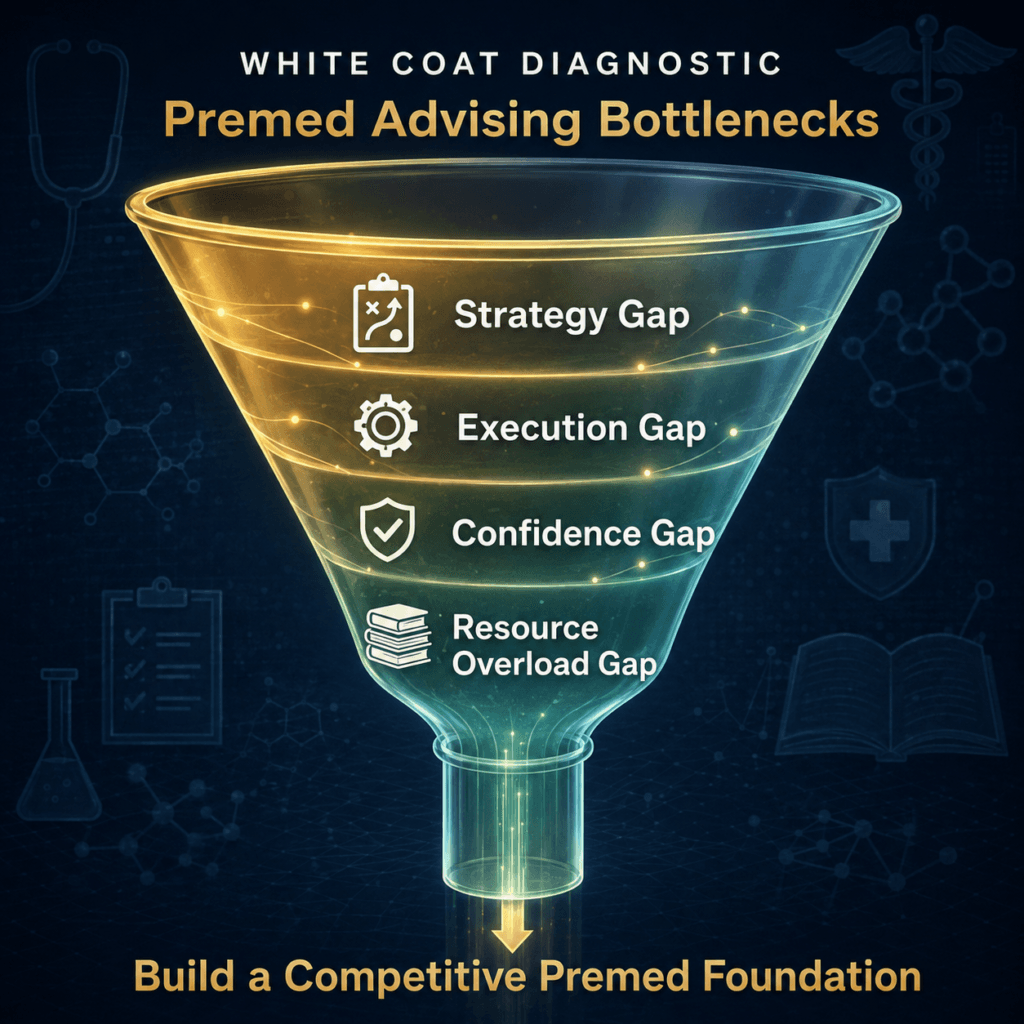
You do not need your entire path figured out today. You need enough clarity to make the next best decision.
If your Premed Advising bottleneck is strategy, you may be doing premed activities, but not yet following a clear plan that connects your goals, timeline, academic record, experiences, and application readiness.
This can show up as:
➢ Not knowing which activities matter most right now
➢ Feeling unsure whether to focus on grades, clinical experience, research, volunteering, shadowing, or MCAT preparation
➢ Following advice from multiple people without knowing what applies to your situation
➢ Making decisions one semester at a time instead of building toward a competitive application
➢ Worrying that you are “behind” but not knowing what actually needs to change
The goal is to turn scattered premed effort into a clear plan for becoming a competitive applicant.
If your Premed Advising bottleneck is execution, you may have a general idea of what you should be doing, but the work is not happening consistently enough to build momentum.
This can show up as:
➢ Starting plans but struggling to follow through
➢ Delaying emails, applications, scheduling, studying, or activity searches
➢ Knowing you need clinical exposure or volunteering but not taking the next concrete step
➢ Letting the semester get busy before your premed goals have structure
➢ Feeling like you are always catching up instead of steadily building your application
The goal is to turn your premed plan into a realistic weekly system you can actually follow.
If your Premed Advising bottleneck is confidence, you may be questioning whether you are the kind of student who can realistically become a physician.
This can show up as:
➢ Comparing yourself to other premed students and feeling behind
➢ Worrying that one grade, one semester, or one weakness has already ruined your chances
➢ Avoiding opportunities because you do not feel ready yet
➢ Second-guessing whether your story, background, or academic path is “good enough”
➢ Feeling uncertain even when you are making real progress
The goal is to build confidence from evidence, direction, and steady progress rather than comparison.
If your Premed Advising bottleneck is resource overload, you may be surrounded by too much advice and too many possible next steps.
This can show up as:
➢ Getting conflicting advice from advisors, peers, family, online forums, and social media
➢ Not knowing which premed requirements, activities, or timelines actually apply to you
➢ Saving resources, checklists, videos, and posts without turning them into action
➢ Feeling more anxious after researching what to do
➢ Trying to build your path from everyone else’s plan instead of your own situation
The goal is to simplify the noise into a focused premed roadmap that matches your timeline, goals, and current starting point.
Our plan tells you what matters now — and what can wait.
Without a clear sequence, a full calendar can still leave you unsure whether all your academic and extracurricular activities are building the right foundation.
DDQX Learning helps you connect your direction, academics, experiences, and timeline.
- Choosing activities because they seem important
- Trying to strengthen every part of your profile at once
- Planning one semester at a time without a long-term map
- Wondering when you should begin MCAT preparation
- Feeling behind without knowing what needs attention
- Each semester has a defined priority
- Prerequisites and academics fit your timeline
- Extracurricular experiences have clear roles
- MCAT prep begins when your foundation supports it
- Progress is reviewed by evidence and defined decisions
DDQX meets your timeline, budget, and need for accountability.
Every pathway tailors guidance to your particular circumstances and passions.
Choose the pathway that helps you reach your desired outcome in the setting you prefer.
Free Resource Hub
Guides, sample cases, and tools to help learners study with more structure and discipline.
Personalized Strategy Reports
Expert-built study plans, admissions feedback, and competitiveness analyses.
1-on-1 Coaching & Tutoring
Personalized, ongoing support for study planning, applications, and exam preparation.
DDQX Courses & Community
Cohort-based, expert-led guidance on achieving your goals with DDQX Learning methods.
Premed Advising is the 1st stage in the White Coat Journey.
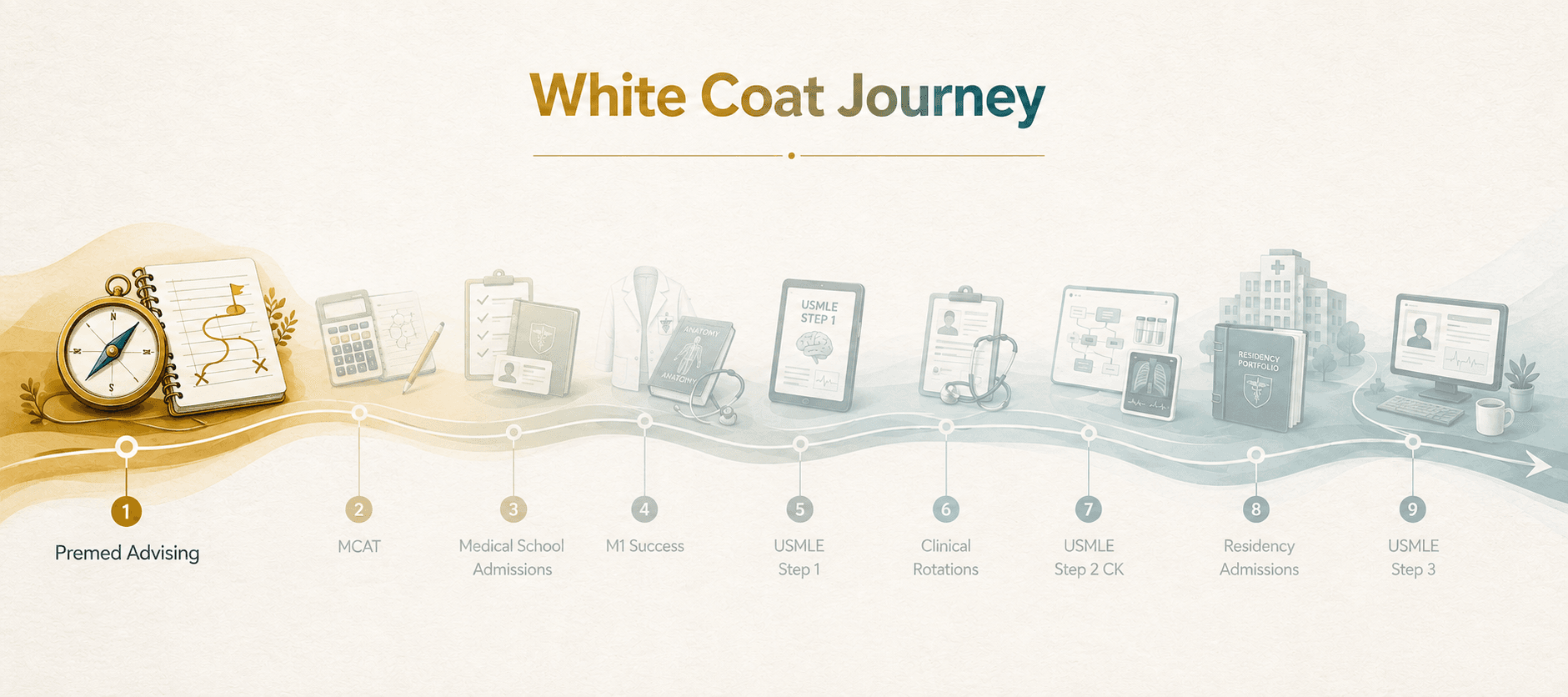
If you are gathering premed experiences now, focus on each activity having a role in demonstrating your physician readiness. If you've completed your foundational academics, the next step is preparing for the MCAT.
Premed Advising — Frequently Asked Questions
What does DDQX Premed Advising help with?
Premed Advising helps you build a practical path toward medical school by connecting four areas that are often planned separately: your career direction, academics, experiences, and ability to execute the plan. We look at what you are working toward, what evidence you already have, where important gaps remain, and which decisions deserve your attention next.
Who is Premed Advising for?
Premed Advising can be useful for college students, postbaccalaureate students, career changers, gap-year students, and other prospective medical students who want more structure around their path. You do not need to have your entire medical school timeline figured out before seeking advising. Uncertainty about your timeline, priorities, experiences, or readiness is often a good reason to start.
Can you help me decide whether medicine is the right career for me?
Yes. Career exploration is part of the advising process. Rather than forcing an early commitment, we help you examine what you have actually learned about physicians’ work, patient care, healthcare teams, professional responsibilities, and the realities of medical training. You can then identify what additional experiences or conversations would help you make a better-informed decision.
How is DDQX Premed Advising different from following a standard premed checklist?
A checklist can tell you what other applicants commonly do. Advising should help you determine what makes sense for your situation. Your academic record, institution, finances, work obligations, available time, career questions, application goals, and existing experiences all affect the sequence of your plan. We use those factors to identify priorities and define specific points when the plan should be reviewed.
Do I need clinical experience, research, volunteering, shadowing, and leadership?
There is no useful reason to collect activities simply to fill categories. We look at the purpose and quality of your experiences: what you contributed, what responsibility you held, what you learned, how you responded to feedback, and whether the experience helped you better understand medicine or develop relevant competencies. One meaningful experience may accomplish several of those goals.
Can you help me plan my prerequisite courses?
We can help you organize prerequisite planning within your larger academic and application timeline. Medical school requirements vary, however. You should verify current coursework, credit, testing, residency, citizenship, and other requirements through your institution and the individual medical schools you may apply to. DDQX advising can help you identify what needs verification and incorporate those requirements into a workable plan.
What if my GPA or academic performance is not where I want it to be?
Academic trajectory is one of the major areas we evaluate. The first priority is understanding what is contributing to the problem and what can realistically be changed. That may involve course planning, study systems, workload, tutoring, access services, health support, financial pressures, or other factors affecting performance. From there, the plan should include a specific action, the support needed, and a date to reassess progress.
When should I start studying for the MCAT?
The best time depends on more than your year in school. We look at whether your science foundation is sufficiently developed, how the exam fits your intended application year, whether you have protected study time, what other responsibilities compete for that time, and whether your study resources and support system are ready. Once those pieces are stable enough for deliberate preparation, the next stage is the DDQX MCAT Roadmap.
Can you help me decide whether I should take a gap year?
Yes. A gap year can be evaluated as part of your overall sequence rather than as an isolated decision. We can look at what additional time would allow you to accomplish, including academic strengthening, sustained experiences, MCAT preparation, financial planning, application development, or career exploration. The useful question is whether changing the timeline meaningfully improves your readiness and gives you a plan you can execute.
What happens during a Premed Advising Strategy Call?
The strategy call is designed to turn your current situation into a practical next plan. Bring your academic map, current experiences, major constraints, expected timeline, and the decision you are trying to make. We use those pieces to identify the highest-priority issues and organize them into a focused 90-day plan with clear next actions and review points.
How far ahead should my premed plan go?
You should understand the major milestones ahead without trying to predict every semester in detail. We generally think across three planning horizons: what needs attention during the next 90 days, what should develop over the next 3–12 months, and how major events such as prerequisites, the MCAT, graduation, a gap period, and the application cycle fit together over the longer term. The closer the decision, the more specific the plan should become.
What if I am getting conflicting advice from advisors, friends, online forums, and other premed resources?
Start by identifying the actual decision you are trying to make. Then separate school-specific requirements from personal strategy. Requirements should be checked against authoritative sources. Strategic decisions should be evaluated against your academic record, experiences, timeline, constraints, and goals. The objective is to give each source of information a defined role so that additional advice improves the plan rather than creating more uncertainty.
Does DDQX replace my college prehealth advisor?
No. Your institutional advisor can be an important part of your support system, especially for school-specific policies, course planning, committee processes, and local resources. DDQX Premed Advising can complement that support by helping you connect the different pieces of your journey, define the decisions in front of you, and build an executable strategy around them.
Can Premed Advising guarantee that I will get into medical school?
No advisor can responsibly guarantee an acceptance. Admissions decisions depend on many factors, including academic performance, experiences, competencies, MCAT performance, application quality, school selection, interviews, institutional priorities, and the applicant pool. Our role is to help you make better-informed decisions, strengthen areas that are within your control, and build a coherent path toward application readiness.