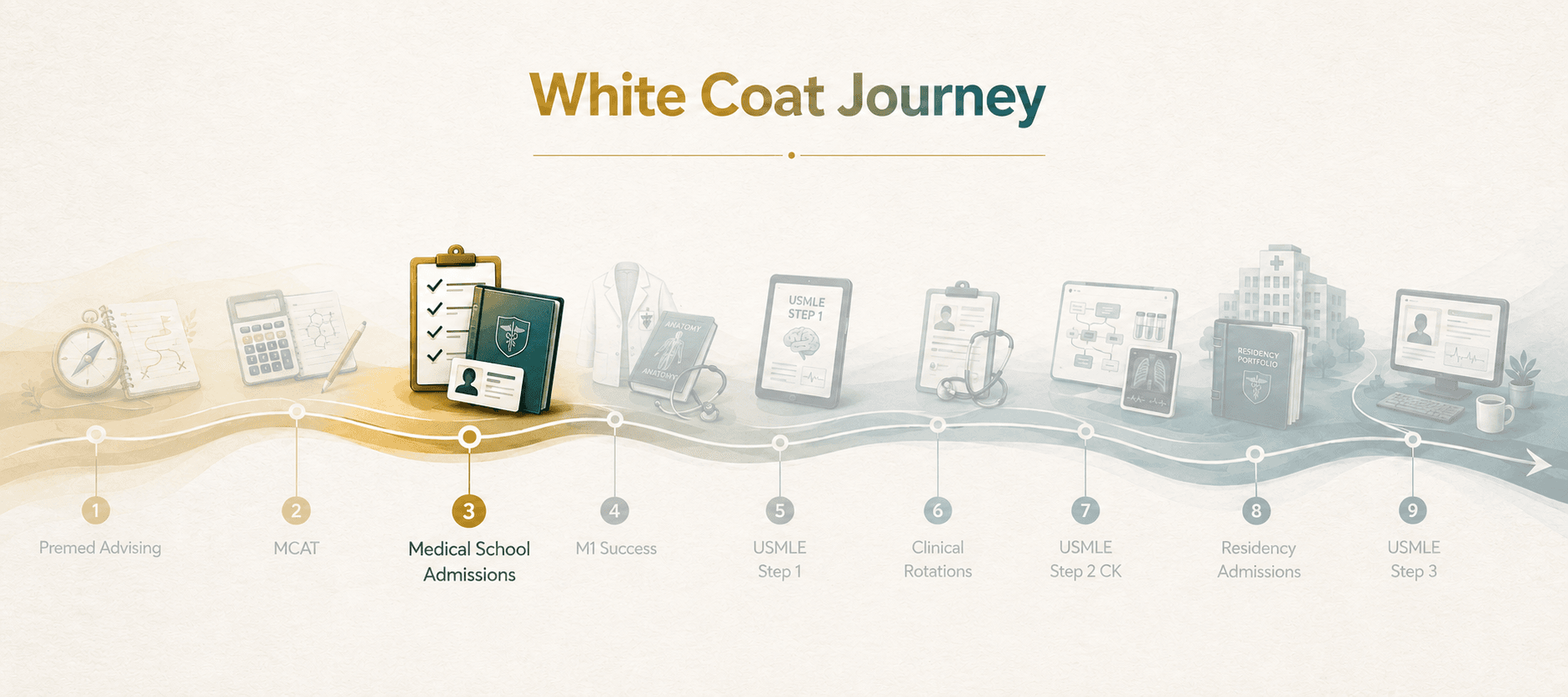
White Coat Journey
DDQX Approach to Medical School Admissions
Turn your lived experiences into a physician-readiness story.
Medical school admissions is as much a reasoning task about admissions strategy as it is a writing task.
You have to decide which experiences matter, what they prove, how they connect, and why they support your readiness for medicine.

Your MCAT & GPA show only part of the picture.
Medical school admissions committees are trying to understand the kind of physician you are preparing to become, not just your past academics and achievements.
It's rare that nothing of interest happened in your life.
The issue is deciding what belongs in your application and what each piece is supposed to show.
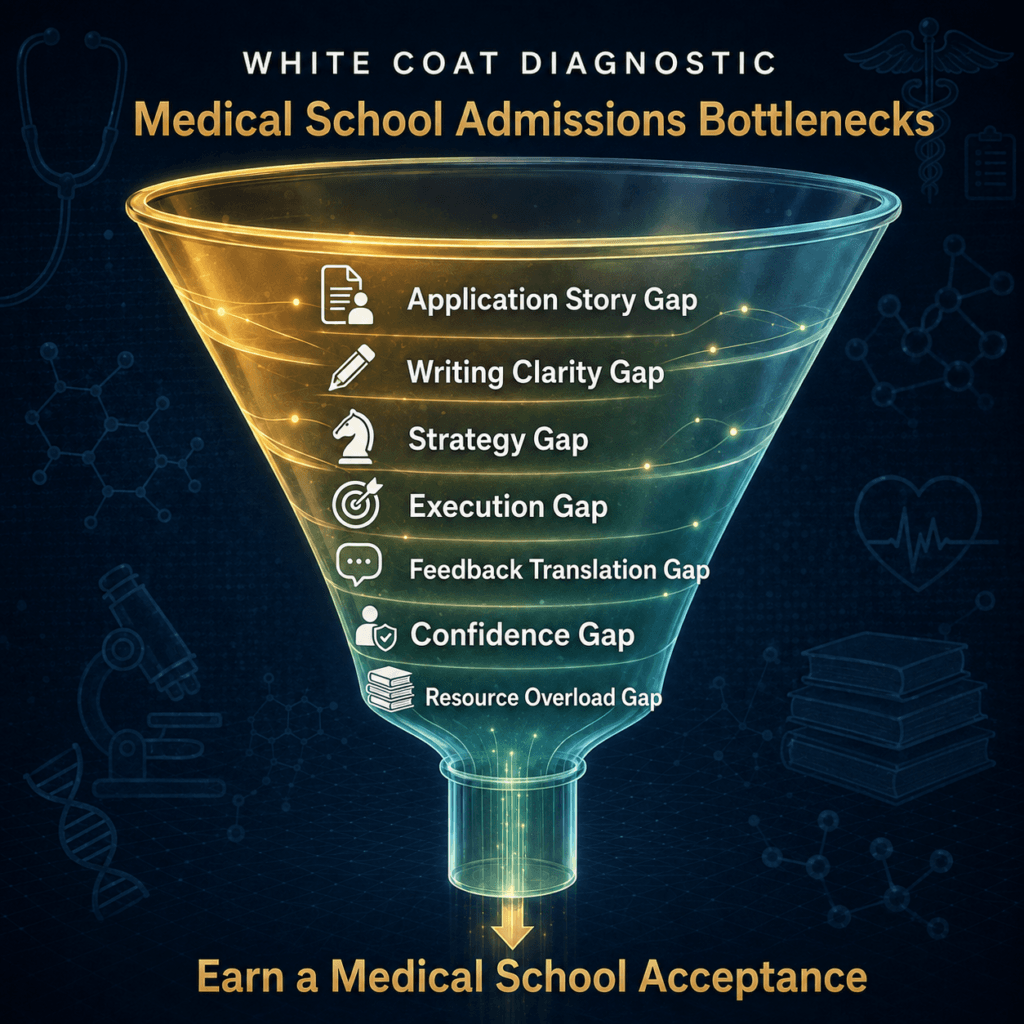
If your admissions bottleneck is your application story, you may have meaningful experiences, but they may not yet come together into one clear argument for why medicine, why you, and why now.
This can show up as:
- ➢ A personal statement that feels sincere but unfocused
- ➢ Activities that are strong individually but disconnected as a whole
- ➢ Too many themes competing for attention
- ➢ A motivation for medicine that feels implied rather than clearly developed
- ➢ Describing what happened without showing what it revealed about you
- ➢ An application that feels busy but not yet cohesive
The goal is to turn your experiences into a coherent physician-readiness narrative.
If your admissions bottleneck is writing clarity, you may know what you want to say, but the current wording may not yet make that message easy for an admissions reader to follow.
This can show up as:
- ➢ Long sentences that bury the main point
- ➢ Vague reflections that do not reveal enough about you
- ➢ Generic conclusions that could apply to many applicants
- ➢ Abrupt transitions between experiences or ideas
- ➢ Essays that explain what happened but do not clearly show what changed in you
- ➢ Strong experiences that lose impact because the writing feels crowded or indirect
The goal is to help your application say the right thing with less noise.
If your admissions bottleneck is strategy, you may be working on the application, but the pieces may not yet be organized around a clear plan.
This can show up as:
- ➢ Uncertainty about which stories belong in the personal statement versus the activities section
- ➢ Difficulty deciding how to approach secondary essays
- ➢ A school list that may not fully match your profile or goals
- ➢ Not knowing how to address a weakness without overexplaining it
- ➢ Strong experiences that are not being used in the right places
- ➢ Application components that feel disconnected from one another
The goal is to clarify what matters most, decide what each part of the application needs to accomplish, and sequence the work intelligently.
If your admissions bottleneck is execution, you may understand what needs to happen, but the work may not yet be moving forward consistently enough.
This can show up as:
- ➢ Personal statement drafts staying unfinished
- ➢ Secondary essays piling up faster than you can complete them
- ➢ Activity descriptions remaining incomplete or underdeveloped
- ➢ Interview preparation getting delayed
- ➢ School list decisions lingering too long
- ➢ Application tasks feeling urgent but not clearly prioritized
- ➢ The timeline starting to control you instead of the other way around
The goal is to turn the admissions process into a system you can actually complete.
If your admissions bottleneck is feedback translation, you may have received advice from advisors, mentors, friends, physicians, editors, online forums, or previous application reviewers, but the feedback may not yet be turning into a stronger application.
This can show up as:
- ➢ Getting conflicting advice from different people
- ➢ Revising in circles without feeling closer to a final draft
- ➢ Making wording changes without improving the deeper story
- ➢ Feeling unsure which feedback to trust
- ➢ Applying every suggestion equally instead of deciding what matters most
- ➢ Losing your own voice while trying to satisfy too many reviewers
The goal is to separate useful feedback from noise and translate the right comments into concrete revisions.
If your admissions bottleneck is confidence, you may be carrying more uncertainty than your application deserves.
This can show up as:
- ➢ Second-guessing every essay or activity description
- ➢ Comparing yourself constantly to other applicants
- ➢ Avoiding submission because the application never feels ready
- ➢ Assuming one weakness defines the entire file
- ➢ Rewriting strong material until it loses clarity or personality
- ➢ Feeling unable to tell whether your application is actually improving
The goal is to help you see your application clearly enough to improve it without losing trust in yourself.
If your admissions bottleneck is resource overload, you may be surrounded by too many inputs.
This can show up as:
- ➢ Feeling more anxious after researching than before
- ➢ Comparing your application to too many sample essays
- ➢ Changing your writing style based on every new opinion
- ➢ Losing track of your own story because you are trying to follow too many examples
- ➢ Treating every checklist as equally important
- ➢ Spending more time gathering advice than making decisions
The goal is to simplify the process so each resource supports the application instead of adding more confusion.
The hidden problem is usually story architecture.
Why medicine? Why now? How do you respond under stress? How do you learn from difficulty? How do you work with others? What evidence suggests you are ready for this?
DDQX Learning ensures that your experiences support believable answers to these.
- Personal statement reads like a timeline.
- Activities section reads like a resume.
- School list is a spreadsheet without strategy.
- Secondary essays recycle answers from primary.
- Interview answers sound like lists of traits.
- Personal statement clearly shows physician-readiness.
- Activities section shows service, judgment, and growth.
- School list reflects fit, risk, mission, and strategy.
- Secondary essays answer prompts without recycling.
- Interview answers show reasoning and composure.
DDQX meets your timeline, budget, and need for accountability.
Every pathway tailors guidance to your particular circumstances and passions.
Choose the pathway that helps you reach your desired outcome in the setting you prefer.
Free Resource Hub
Guides, sample cases, and tools to help learners study with more structure and discipline.
Personalized Strategy Reports
Expert-built study plans, admissions feedback, and competitiveness analyses.
1-on-1 Coaching & Tutoring
Personalized, ongoing support for study planning, applications, and exam preparation.
DDQX Courses & Community
Cohort-based, expert-led guidance on achieving your goals with DDQX Learning methods.
Medical Admissions is the 3rd stage in the White Coat Journey.